A Performance Analysis of Pulling Rate Based on Image Layer Concurrency Level in Docker Environment for Cold Start Mitigation
Annual Conference of KIPS (ACK 2023)
Summary
More concurrent layer downloads do not always make image pulling faster. The study varies image size, registry location, and concurrency to compare pull times.
- Role
- Second authorimage-pulling performance analysis
- Outcome
- At 10Mbps with ten layers, concurrency of 5–7 generally worked well; the 10MB Tokyo case continued improving at higher concurrency.
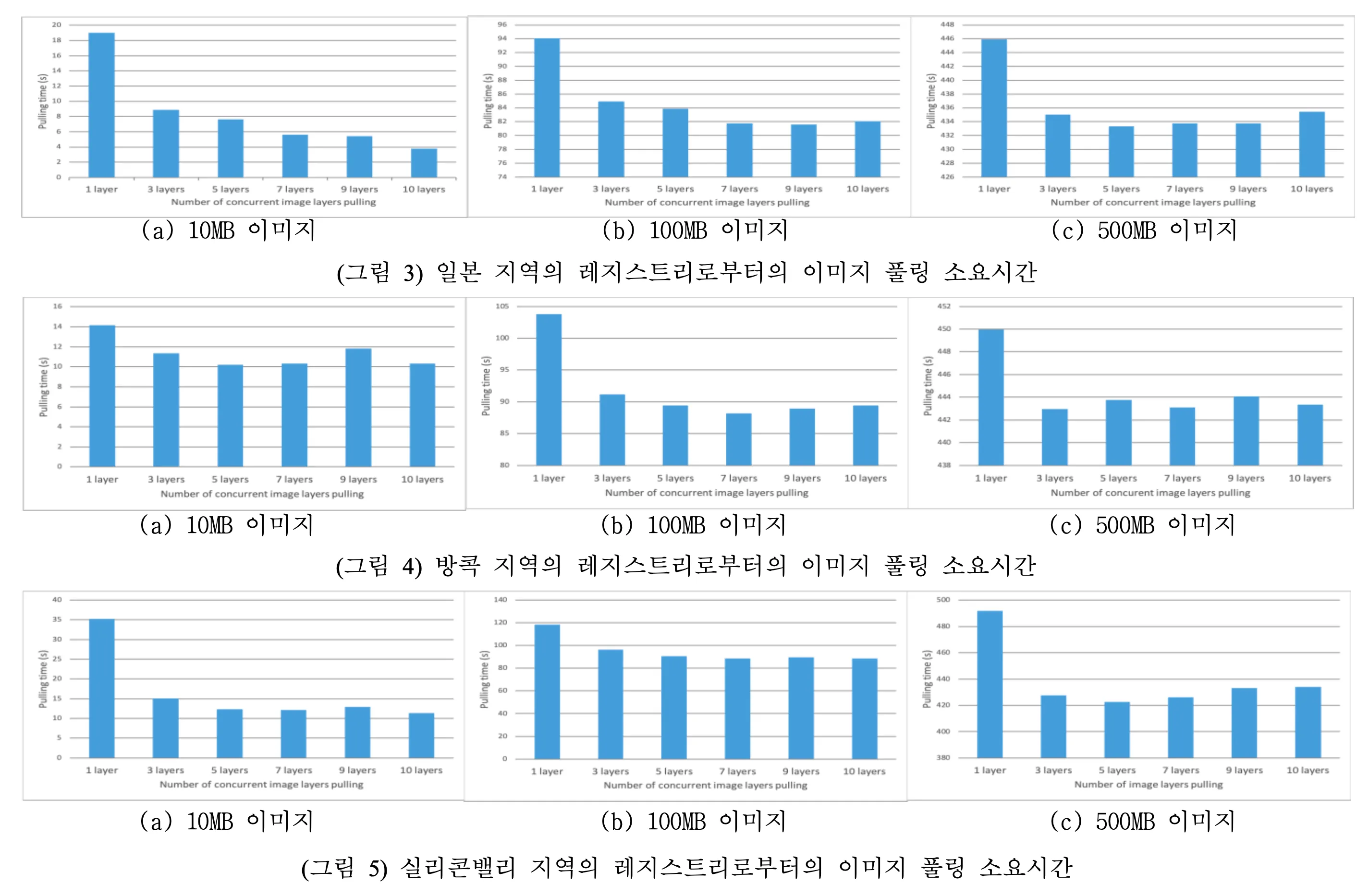
Image Downloads That Prolong Cold Starts
A cold start includes the delay of initializing and launching a container for a serverless function. Pulling its image from a remote registry contributes to that delay. The study examined whether faster image pulling could help mitigate cold starts.
The experiments adjusted the number of image layers Docker downloads concurrently. They tested whether increasing concurrency beyond the default of three improved pulling speed, and how image size and registry location affected the result.
An image consists of multiple layers, with Docker downloading a configured number concurrently. Even at the same total image size, concurrency can change completion time. The study focuses on settings and duration of the image-pulling stage within cold start.
Concurrent Pulls Across Image Sizes and Registry Locations
The Tencent Cloud setup placed the client in Seoul and private Docker registries in Tokyo, Bangkok, and Silicon Valley. Each image contained ten layers. Layer sizes of 1MB, 10MB, and 50MB produced total image sizes of 10MB, 100MB, and 500MB.
Every image used 10 layers so that, within a size setting, only pulling concurrency changed. Registry locations were compared from the same client to examine image size and transfer-path effects separately.
The experiments used Intel Xeon Cascade Lake, Ubuntu 22.04, and a 10Mbps link. Pull time was measured with time docker pull at concurrency levels of 1, 3, 5, 7, 9, and 10. The cache was cleared before each run, with ten repetitions in each of two time windows.
When concurrent downloads help and when gains diminish
With sequential downloading, other layers cannot use bandwidth left idle while one layer is transferred. Concurrent transfers can use that capacity, which the paper uses to interpret shorter total pulling times than sequential processing.
Increasing concurrent tasks does not increase the path’s bandwidth. The paper interprets diminishing or reversed gains as possible effects of bandwidth limits and bottlenecks. Small images from a nearby registry behaved differently, so this download-time experiment needs to be read across image sizes and regions.
Varying Gains from More Concurrent Pulls
On the tested 10Mbps link, parallel downloads were faster than serial downloads, with concurrency of 5–7 generally favorable. Beyond that, gains flattened or reversed.
The 10MB Tokyo case continued improving at higher concurrency. Because image size and registry location changed the result, concurrency needs to be measured for the deployment environment.
The measured outcome is the time to download the full image after clearing the cache. The experiment shows that layer concurrency can shorten this preparation stage; it does not measure a reduction rate for end-to-end cold start, including function initialization and execution.